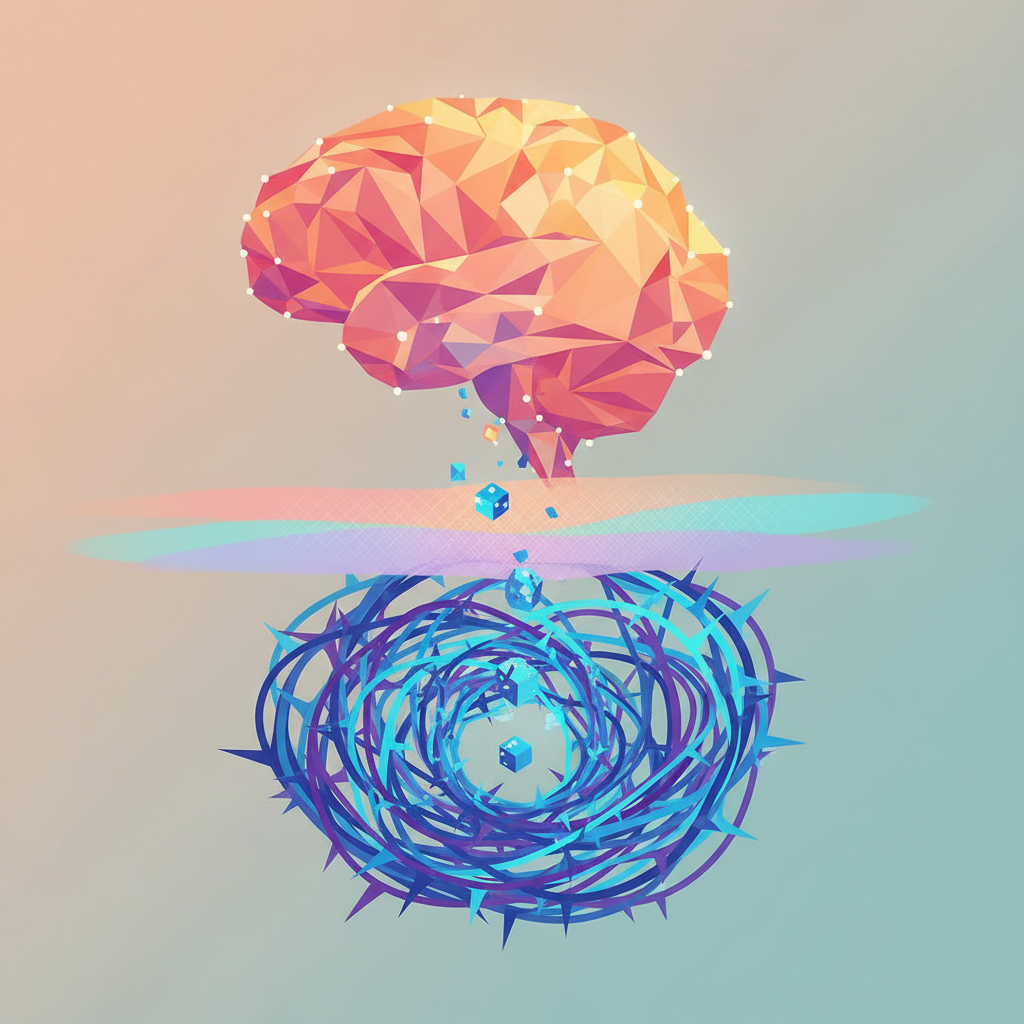
A lot of the “learn AI” content out there is a trap. It promises to teach you a prompt that will solve all your problems. Or it shows you how to generate a month’s worth of social media content in 30 seconds. The output is always, without exception, generic trash. This is not the way.
There is no such thing as a "beginner" when it comes to using AI for professional creative work. You are an expert in your own taste, your own experience, and your own point of view. The only way AI tools are useful is if they help you express that unique perspective. If you are a beginner at that, no AI can help you.
This is the most important lesson you can learn about AI. You are the expert. The AI is a tool. It is an incredibly powerful and flexible tool, but it is still a tool. It doesn’t have taste. It doesn’t have a point of view. It has no actual understanding of the work you do. You have to provide all of that.
Your Taste is the Algorithm
Taste is the most valuable asset you have as a designer or creative. It is the collected library of everything you’ve ever seen, read, or experienced. It is your unique filter on the world. When you use an AI tool, your job is not to accept its first answer. Your job is to guide it toward an output that aligns with your taste.
Think of it like a collaboration with a very fast, very naive intern. This intern can generate a hundred ideas in a minute, but ninety-eight of them will be terrible. Two of them might have a spark of something interesting. Your job is to spot that spark and cultivate it.
You do this through conversation. You give the AI a starting point, you evaluate its response, and you give it specific, targeted feedback based on your own knowledge and taste. You are the creative director. The AI is the production artist. This is the only healthy way to think about this relationship.
Forget about "magic prompts." They do not exist. A prompt that works for one person’s taste will produce garbage for another. The secret is not the prompt; it is the iterative process of refinement. It is a dialogue between your expertise and the AI’s generative power.
The Myth of the Blank Page
Many people look to AI to solve the "blank page" problem. They want the AI to give them the first idea, the starting point. This is usually a mistake. An AI-generated starting point is, by definition, generic. It is the statistical average of all the text it was trained on.
Your work should never start from an average. It should start from a specific point of view—yours. Before you ever open Claude or ChatGPT, you should have done the hard work of thinking. What is the goal of this project? Who is the audience? What is the core message? What is the unique angle only you can bring to it?
Bring your own material to the conversation. Don’t ask the AI for "ideas for a marketing campaign." Instead, give it your detailed project brief, your customer research, your half-formed ideas, and your brand voice guidelines. Then, ask it to act as a brainstorming partner. Ask it to find weaknesses in your argument. Ask it to generate variations on your ideas, not its own.
When you start with your own thinking, the AI becomes a powerful amplifier. It can help you explore possibilities and refine your concepts at a speed that was previously unimaginable. But it cannot do the initial, essential work of having a point of view.
Build a System, Not a Prompt Library
The goal is not to collect a library of clever prompts. The goal is to build a system for producing high-quality, original work that reflects your creative direction. This is what we focus on in The Connected Studio.
Your system should include a few key components:
- A clear project brief: Before you touch the AI, you need to know what you’re trying to achieve. This is non-negotiable.
- Your own raw material: This includes your notes, your research, your brand guidelines, your swipe file of examples you admire. The more of your own thinking you can feed the AI, the better the output will be.
- An iterative feedback process: Your first prompt is the start of a conversation, not the end. Be prepared to go back and forth with the AI, refining and redirecting its output until it meets your standards. This is where the real work happens.
This approach is harder than copying and pasting a "magic prompt." It requires you to be an active, opinionated participant in the creative process. It requires you to have taste and a point of view. But it is the only way to use these tools to create work that is truly your own.
The Bottom Line
Stop looking for beginner AI tutorials. You are not a beginner. You are an expert in your own craft and your own taste. The challenge is not to learn how to use AI, but to learn how to direct AI to produce work that is worthy of your name. It means trading the illusion of easy, instant answers for a robust, reliable system for generating original work. It’s a system that puts your expertise, not the AI’s, at the center of the process.
This is the entire philosophy behind The Connected Studio. You can learn the complete system for building an AI-assisted one-person design business in our field manual. The Connected Studio field manual contains the full system. It is available at https://connectedstudio.app/.