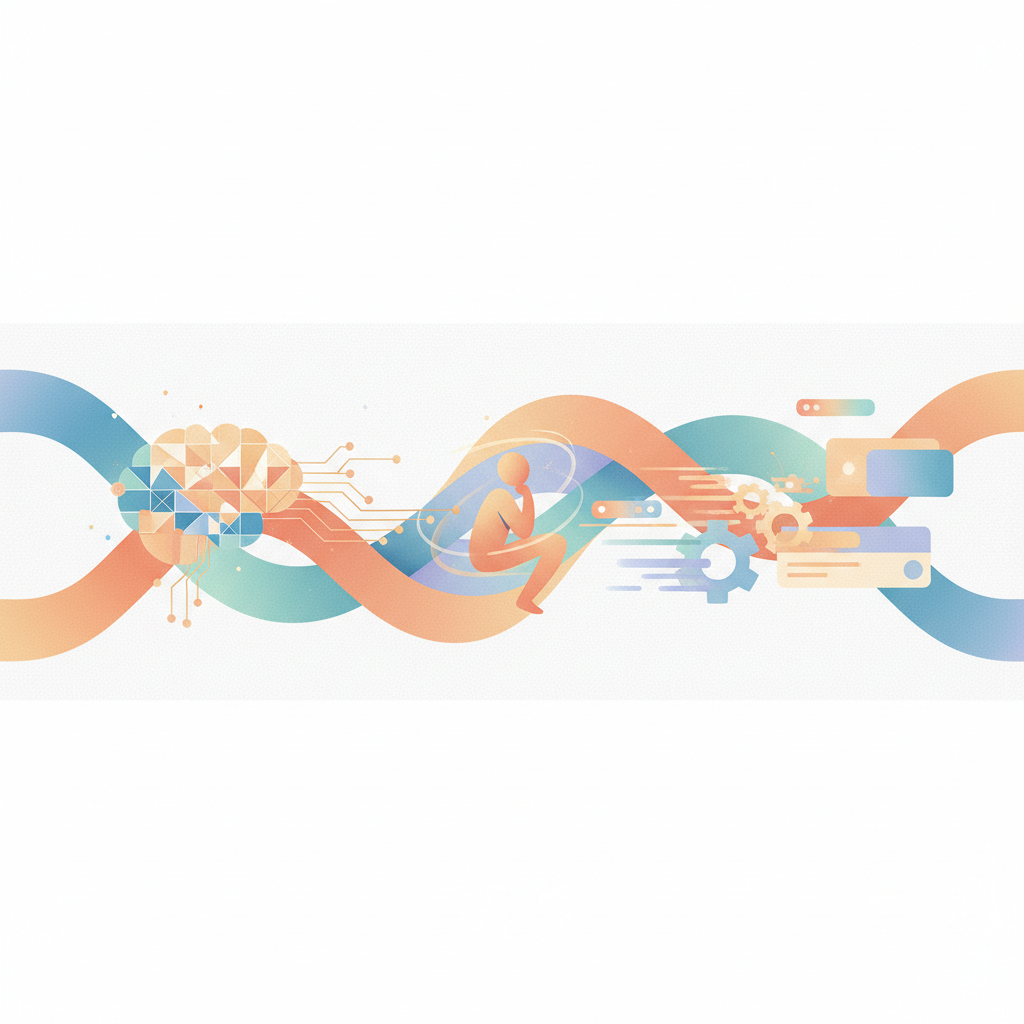
AI isn't going to replace UX designers. It's going to make the good ones better, especially for solo operators. The promise of artificial intelligence in design isn't about automation that takes away jobs, but about augmentation that amplifies the capabilities of a single person. For a one-person UX design studio, that means delivering higher quality work, faster, and with more confidence.
Research and Discovery: Expanding Your Reach
User research is often the most time-consuming part of the UX process. For a solo designer, conducting extensive interviews, surveys, and competitive analysis can be a bottleneck. AI helps here by automating data synthesis and making sense of qualitative data at scale.
You can feed transcripts of user interviews into AI models (like Claude) and ask for summaries, identification of recurring themes, pain points, and unmet needs. This isn't about outsourcing the synthesis entirely, but about getting a quick, organized first pass that you, the expert, can then refine and interpret. Similarly, for competitive analysis, AI can quickly digest numerous websites and apps, identifying common patterns, unique selling propositions, and areas of opportunity that might take days to uncover manually.
Ideation and Concept Development: A Smarter Brainstorming Partner
Coming up with novel ideas on your own can be challenging. A key benefit of design teams is the collaborative brainstorming process. For a solo designer, AI can serve as a tireless, non-judgmental brainstorming partner.
Describe a problem or user need to an AI, and ask for a diverse range of potential solutions, features, or interaction patterns. While many suggestions might be generic, the AI can often spark an unexpected idea or connect disparate concepts you hadn't considered. This isn't about letting AI design for you; it's about using it to expand your cognitive reach. You remain the filter, the curator, and the ultimate arbiter of what makes sense for the user and the business.
Prototyping and Iteration: Speeding Up the Cycle
Creating initial wireframes and prototypes, especially for testing concepts, can be monotonous. AI, particularly in conjunction with design tools, is beginning to streamline this significantly.
Text-to-UI tools are emerging that can generate basic layouts from descriptive prompts. While these are far from perfect, they can provide a starting point for common UI patterns, freeing you from the repetitive drag-and-drop. More practically, AI can assist in generating diverse content for prototypes – placeholder text that feels real, or even simple image suggestions that fit the context. This allows you to focus on the core interaction and flow rather than the minutiae of populating every screen, accelerating your iteration cycles.
Content Generation: The Unsung Hero of UX
UX writing is a critical, yet often overlooked, part of product design. For a solo designer wearing multiple hats, generating clear, concise, and helpful microcopy, error messages, and onboarding text can be a significant time sink. This is where AI truly shines.
Provide an AI with the context of a screen or interaction, and ask for suggestions for button labels, error messages, or instructional text. You can specify tone, length, and purpose. While you'll always need to review and refine, AI can produce multiple options instantly, ensuring consistency and clarity across your product's language. This doesn't replace a dedicated UX writer, but it enables a solo designer to maintain a high standard of communication within their designs, a crucial aspect of overall user experience.
The bottom line
AI is not a silver bullet, nor is it a replacement for skilled UX designers. For one-person teams, it's an invaluable assistant that automates monotonous tasks, expands creative capacity, and accelerates workflows across every stage of the design process. It allows solo practitioners to compete more effectively, deliver higher quality work, and maintain their focus on strategic thinking and user empathy, rather than getting bogged down in repetitive execution. The future of solo UX design is enhanced, not diminished, by AI. Mastering these tools means building a more robust and profitable solo studio.
The full system for running an AI-assisted design business, including practical applications of these principles, lives in The Connected Studio field manual at https://connectedstudio.app/.